
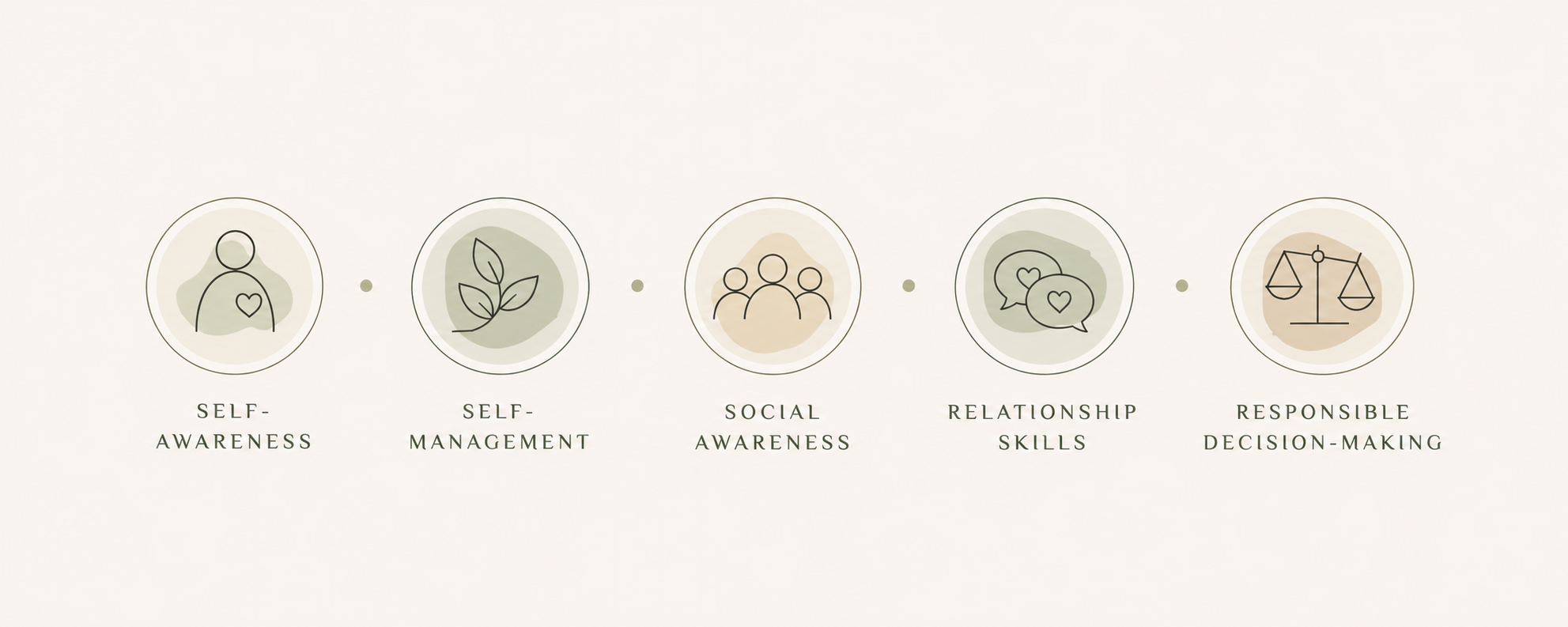
Built using the fundamentals of social-emotional learning (SEL) and the CASEL 5 Framework
Rooted in Resilience was built using the fundamentals of social-emotional learning (SEL) and the CASEL 5 Framework.
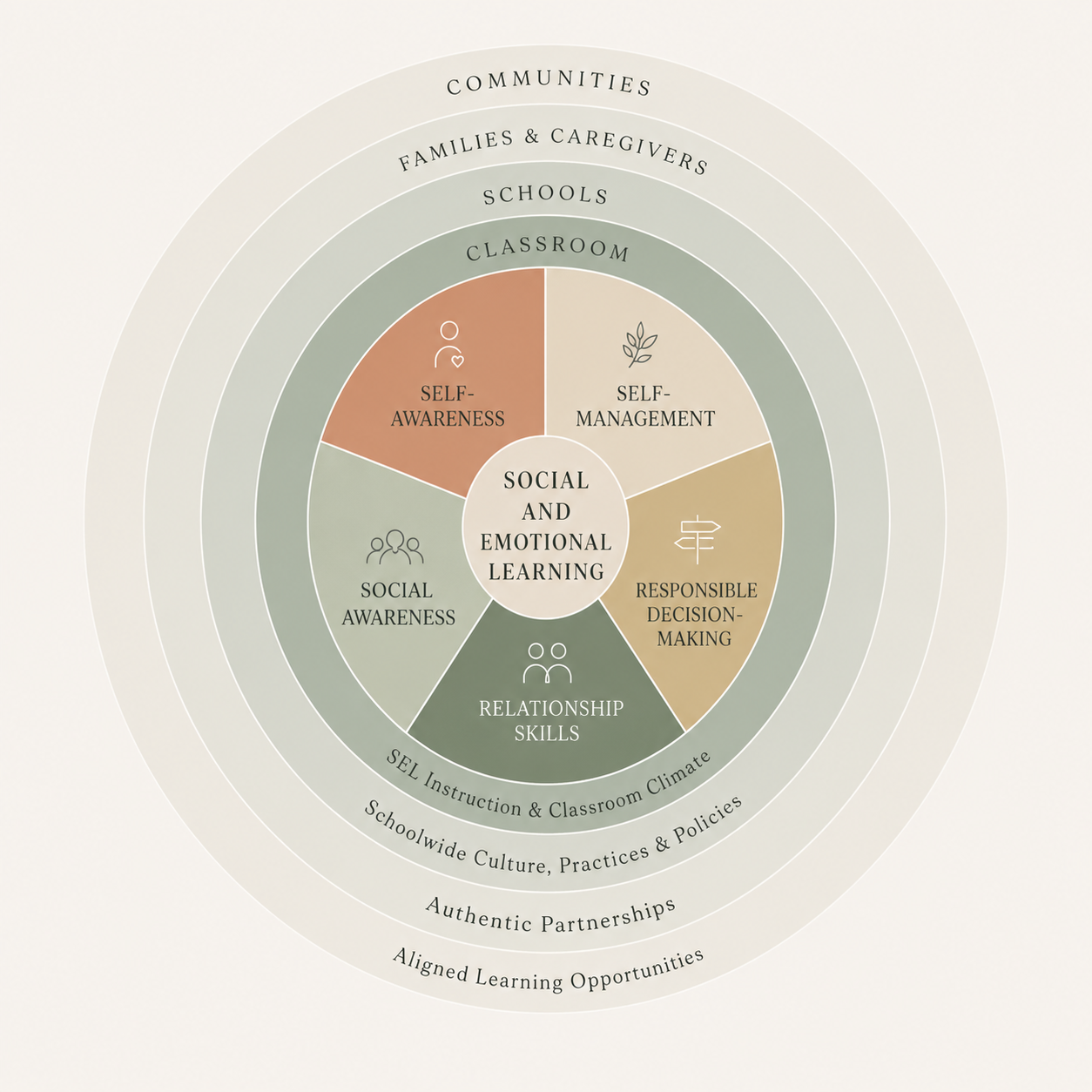
The CASEL Framework refers to five areas of competence that we believe to be crucial in an individual’s social-emotional development.
CASEL’S SEL FRAMEWORKWhy SEL and CASEL 5 Learning?
Social and Emotional Learning (SEL) is the process through which children develop the skills needed to understand and manage emotions, build healthy relationships, show empathy, make responsible decisions, and work toward personal goals. These skills help children grow with confidence, resilience, and a stronger sense of self.
The CASEL 5 Framework identifies five interconnected areas of social-emotional development: self-awareness, self-management, social awareness, relationship skills, and responsible decision-making. These core competencies help children build the skills needed for emotional well-being, healthy relationships, academic success, and confident engagement in everyday life.
The CASEL 5 can be nurtured and strengthened throughout childhood and adolescence, providing children with lifelong tools to navigate challenges, build meaningful connections, and thrive.
Self-AwarenessDeveloping interests and sense of purpose
Identifying one’s emotions
Demonstrating honesty and integrity
Linking feelings, thoughts, and behaviors
Social AwarenessTaking perspective of others
Recognizing strengths in others
Demonstrating empathy and compassion
Showing concern for the feelings of others
Relationship SkillsCommunicating effectively
Developing healthy and positive relationships
Practicing team-work and collaboration
Resolving conflict peacefully and productively
Experiencing self-efficacy
Practicing a growth mindset
Understanding and expressing gratitude
Resisting negative social pressure
Standing up for the rights of others
Showing leadership in groups
Seeking and offering help when needed
Self-ManagementManaging and regulating emotions
Identifying and using healthy coping skills and strategies
Exhibiting self-discipline and self-motivation
Setting goals
Using planning and organization skills
Showing courage to take initiative
Responsible Decision-MakingDemonstrating curiosity and open-mindedness
Identifying solutions for personal and social problems
Anticipating and evaluating consequences for one’s actions
Reflecting on one’s role to promote personal and community well-being
Evaluating personal and interpersonal impacts
Demonstrating personal and collective agency
What to know before getting started
Not sure where to start? Reach out with any questions, or if you're ready to dive right in, schedule a free consultation today.
-
If you asked 10 people what SEL is, you would absolutely get 10 different answers. At its core, social and emotional learning (SEL) is the process through which people acquire and apply the knowledge, skills, and attitudes to develop healthy identities, manage emotions, achieve goals, feel and show empathy, make responsible decisions, and establish healthy relationships.
-
At Rooted in Resilience, mentoring is designed to support the whole child through encouragement, emotional skill-building, and meaningful connection in a safe and nurturing environment. While mentoring can be incredibly beneficial for many children, families seeking clinical mental health treatment, diagnosis, or intensive therapeutic support may be best served by a licensed mental health provider.
-
Every child is different and will have their own journey. That said, we believe it is best practice to see a child once a week for at least 6 weeks to begin to see the skills being learned and practiced turn into habits.
-
Rooted in Resilience works best for children aged 4-14 years old. If your child is outside this age range, please book a free consultation and we will work together to see what is best for your child.
-
Individual one-on-one mentorship and parent coaching costs $140 per 45 minute session. Rooted in Resilience also offers packages where families can purchase 4 sessions for $500 at the rate of $125 per session. Small group prices vary depending on size. Consultations are free of charge.
-
Rooted in Resilience is a private pay practice. Payments can be made through Venmo, Zelle, or a check and are required to be paid prior to session.
-
Life happens. Cancellations or reschedules are accepted within 24 hours of the scheduled session. Anything canceled within the 24 hour window will be charged in full.